A digital time capsule · posted or print at home
Seal your files. Keep the only key.
Upload files of any kind, up to 10 GB each and 20 to an order. Each is encrypted and stored indefinitely, and a printed certificate arrives in the post for every one — carrying its fingerprint, the date it was sealed, and the only key that can ever open it.
Sealed for yourself, or for someone else to open years from now.
Your files, stored where no AI can read them — because nobody can, including us.
Evidences that this file existed in this exact form at this moment, anchored under RFC 3161 by freetsa. It makes no claim about who or what created it. This key exists nowhere else — if it is lost, the file cannot be recovered by anyone, including us. The seal record can be reprinted on request. The key cannot.
WC1CETBSYWY1
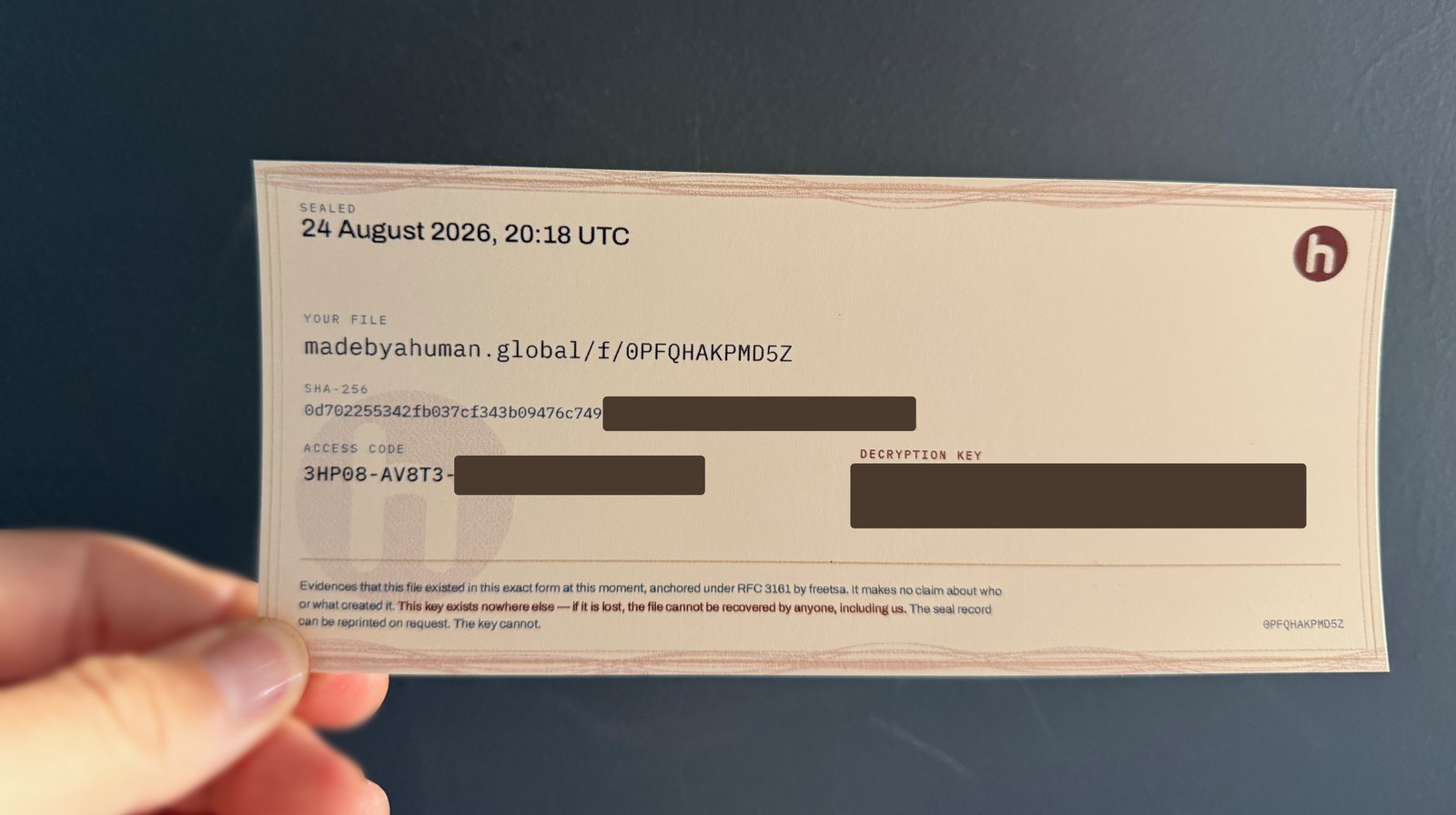
A real certificate, photographed. The decryption key and most of the access code are covered here — on the card that reaches you, they are not.
The certificate
On paper. Printed once. Yours.
200 × 90 mm on heavy stock, printed in-house and posted tracked. Everything needed to reach your file and open it is on this one piece of paper — no app, no account, nothing to remember.
- The address where your file lives
- Its SHA-256 fingerprint, in full
- The moment it was sealed, to the minute
- Your access code, which reaches the file
- Your decryption key, which opens it
You upload it
Any format, up to 10 GB. It goes straight to encrypted storage — there is no account, and nothing to sign up to.
Fingerprinted
We read your file once and compute its SHA-256 — sixty-four characters that change completely if a single byte does.
Timestamped
That fingerprint alone goes to a timestamping authority, which signs the moment it saw it. Your file never leaves.
Encrypted, and the key printed
The file is encrypted. The only key is printed on a card — we post it to you, or you print it yourself.
Our copy destroyed
Then we destroy ours — days after posting, or the moment you download it. From then the card is the only thing in the world that opens it.
Any file, any format, up to 10 GB
- A wedding film
- A debut album master
- A portfolio shoot in RAW
- A first novel
- A YouTube video, before it goes up
- A grandparent’s memoir
- A finished game build
- An architectural model
- A multitrack session
- A letter to a child, to open at eighteen
- A message for a grandchild not yet born
- Wedding vows, for an anniversary decades away
Nothing in the process is format-specific. A 2 MB manuscript and a 9 GB film are the same purchase at different sizes.
What it proves
Three things, all of them demonstrable.
In an age when anything can be generated, this proves yours came first. It makes no claim about who or what made the file — we never look at it, and a certificate that claimed otherwise would be worth nothing.
- This exact file existed on this date
- A SHA-256 fingerprint, anchored to an RFC 3161 trusted timestamp.
- It has not changed since
- Any alteration at all, to a single byte, changes the fingerprint.
- Only you can open it
- The decryption key exists on your certificate and nowhere else.
On the certificate
Two credentials. They do different jobs.
Access code
Reaches your file’s page: the seal date, the fingerprint, the timestamp, and a download of the encrypted file.
The certificate carries the address and the code separately, so the code never travels in a link. Hand the certificate to a solicitor, publisher or insurer and they can open the page, enter the code, see the fingerprint and the date, and check it against the file themselves — without any way to read it. We store the code hashed, like a password.
Decryption key
Opens the file, in your browser. It is printed plainly on the certificate, so there is nothing to scratch off and nothing to go wrong in the post.
We never store it. Once your certificate is delivered, our only copy is destroyed and no copy exists anywhere.
This is not two-factor authentication — both are printed on the same piece of paper. What it gives you is that a breach of our database exposes neither files nor any means of decrypting them.
Why paper
The key is an object, not an account.
Every storage service you use day to day can get back into your files. That is what a password reset is — a way in that does not need you. It is convenient, and it means the means of access is held by somebody other than you.
Here it is a thing you can hold. Your key is ink on paper, in your house. It is not in an account, a recovery email or a password manager, and once your certificate is delivered it is not on our servers either — our copy is destroyed. From that moment the file opens for whoever holds the certificate, and for nobody else. Including us.
As a present
Sealing it for someone else.
The certificate goes to whatever name and address you give us. It does not have to be yours — the delivery address is asked for separately from your payment details, so you can have it posted straight to the person it is for. Posted certificates go to UK addresses only at the moment. We delete the address once it has gone out.
We cannot put a message in with it. The envelope is plain and unbranded — deliberately, given what is inside — and it holds the certificate and nothing else. If you want words of your own to arrive with it, have it posted to you and pass it on yourself.
One thing worth knowing before you send it on. The key is printed on the certificate, so whoever opens the envelope can open the file. Your confirmation email also carries a link that shows the key on screen for 72 hours — useful if you need to check it, and the one thing to leave unopened if you would rather never see it yourself.
Price
One payment, per file. Nothing recurring.
The same flat price whatever the file is and however large, up to 10 GB. Storage is included indefinitely. Up to 20 files per order, each with its own certificate and its own key.
Self-print
£20 / $27Your certificate as a PDF, printed by you. Available anywhere in the world.
- Your file kept for as long as you want it kept — no renewal, no subscription
- Sealed, timestamped and stored the same way
- Credentials shown on screen and in the PDF
- Your key is destroyed the moment you download it
Posted certificate
£40Printed in-house on heavy stock and sent Royal Mail Tracked 24.
- Your file kept for as long as you want it kept — no renewal, no subscription
- Printed on heavy stock at 200 × 90 mm, with a foil seal
- Tracked the whole way, delivered through the letterbox, with no card to collect
- Your key is held for 14 days after posting, then destroyed
- Never handled by a printing company — we print it ourselves
You pay once. That price covers storing your file, encrypted, for as long as you want it kept. There is no renewal, no subscription and no second invoice — and no expiry date after which we quietly delete it. If we ever had to stop, what happens next is written down already.
Prices include everything. Posted certificates go to UK addresses only at present; self-print works anywhere in the world.
Read this before you buy
There is no password reset here, and that is the point. Once your certificate is delivered and our copy of the key is destroyed, we cannot open your file, recover your key, or issue a new one. Nobody can.
If you lose the certificate, the seal record stays valid and provable — we can always reprint the fingerprint, the date and the timestamp. The key is the part that cannot come back. Put the letter somewhere you keep things that matter.